Japan vs Vietnam is not a contest you settle by flipping a coin. In 2023, Japan's GDP per capita hovered around $34,000, while Vietnam's stood near $4,300. That gap shapes everything from factory floors to highway networks. But raw numbers miss the texture. Walk through Hanoi's Old Quarter at 6 a.m. and you'll see street vendors with steel pots, makeshift stools, and a quiet efficiency that feels centuries old. Then ride Tokyo's Yamanote Line during rush hour—masked commuters, synchronized doors, zero delays. Two different rhythms of work and life. The Japan vs Vietnam comparison often reduces to cheap labor versus advanced technology, but the real story lives in the seams: how each country handles pressure, improvisation。and scale.Take manufacturing. Japanese factories in Nagoya still rely on kaizen—continuous improvement—with workers who spend decades on the same line. A Toyota supplier I visited in 2022 had a 78-year-old engineer who could detect a 0.1-millimeter flaw by touch. Vietnam's industrial parks, like those in Bac Ninh。buzz with South Korean and Taiwanese investment. Samsung alone employs over 100,000 Vietnamese workers. The difference?
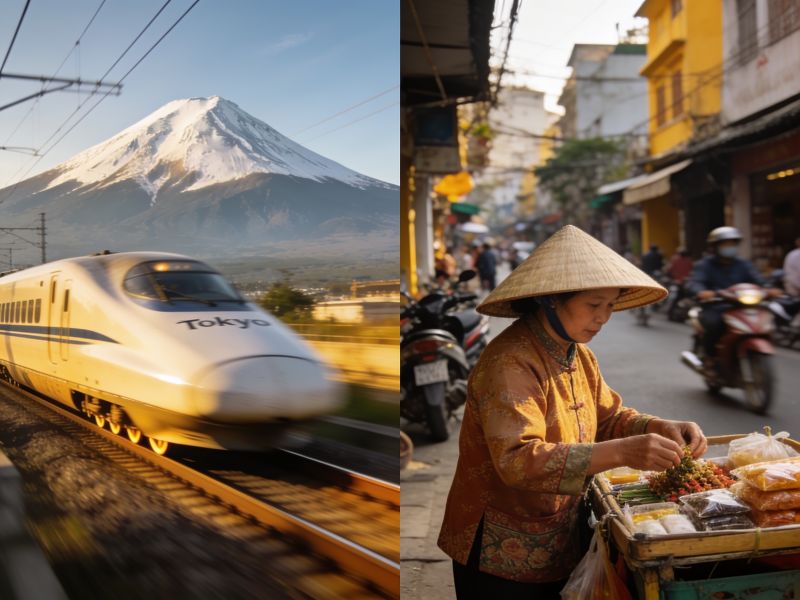
Japanese plants prioritize process discipline;Vietnamese ones emphasize speed and adaptability. A Vietnamese line supervisor told me, half-joking, "We fix problems before the manual arrives." That flexibility wins contracts, but it also means training costs stay high and turnover hovers near 20% annually. Japan vs Vietnam here isn't about better or worse—it's about how each handles imperfection.Infrastructure tells a starker story. Japan's Shinkansen has run since 1964 with an average delay of under one minute. Vietnam's North-South railway still uses colonial-era tracks for parts of its 1,700-kilometer route. A 2024 ride from Hue to Da Nang took 3.5 hours for 100 kilometers—scenic, yes, but slow. Japan's highways are engineering marvels;Vietnam's expressways expand fast but potholes and incomplete interchanges remain common. I once waited two hours for a bus on National Route 1A near Phan Thiet. A local driver shrugged: "Rain。traffic, whatever. You eat, you wait." That improvisational resilience is a strength, but it costs productivity. Japan vs Vietnam in infrastructure is less about money and more about institutional patience—Japan's decades-long planning versus Vietnam's build-first-fix-later energy.Daily life reveals subtler contrasts. Japanese convenience stores stock 200+ onigiri varieties;
Vietnamese markets sell fresh herbs by the handful, no barcode. Japanese trains announce every stop with polite precision;Vietnamese buses stop wherever someone waves. A Japanese colleague once told me he felt "safe but stiff" in Tokyo. A Vietnamese friend in Ho Chi Minh City said she felt "free but tired." Both are right. The Japan vs Vietnam comparison often gets romanticized or dismissed. Neither view holds. Japan's order comes with social pressure;
Vietnam's chaos comes with improvisational warmth. Which works better?Depends on whether you're catching a train or closing a deal.My take: Japan vs Vietnam isn't a rivalry to resolve. It's a reminder that development paths diverge for reasons deeper than policy. Japan's precision took 70 years of post-war discipline. Vietnam's adaptability grew from scarcity and war. Neither is replicable. What's interesting is how they borrow from each other. Japanese firms now send managers to Vietnam to learn rapid prototyping. Vietnamese engineers study Japanese quality control manuals—then rewrite them for local conditions. That cross-pollination might matter more than any ranking. So next time you see a headline pitting Japan vs Vietnam, ignore the scoreboard. Look at the factory floor, the roadside stall, the delayed train. That's where the real story sits.